> ## Documentation Index
> Fetch the complete documentation index at: https://help.moyacascade.com/llms.txt
> Use this file to discover all available pages before exploring further.
# Atemoya farm demo: supplier workflow
> Follow the supplier's fuel, electricity, and ammonia records through to the fertilizer footprint it shares with the farm.
Atemoya Farm Demo buys fertilizer and wants to replace its industry-average emissions estimate with information from the company that makes it. It asks **Fertilizer Supplier Demo** for a footprint for **Fertilizer, 2024, per kg**.
Let's follow the supplier's answer from its factory records to the rate the farm uses on its purchase.
## What does the supplier need to calculate?
The supplier is based in Indonesia. Its accounting period is **1 January–31 December 2024**, and its records are kept separately from the farm's.
It needs two things: the emissions associated with the fertilizer in this sample, and the amount of fertilizer produced. Dividing the first by the second gives emissions **per kilogram of product**, called a **product carbon footprint**, or **PCF**.
**CO₂e** is a common unit for greenhouse gas emissions. A rate in **kgCO₂e/kg** means kilograms of emissions for each kilogram of fertilizer. The two kg units measure different things.
This is a small training model with known gaps. The [data notes](#about-the-sample-data) explain what a real fertilizer assessment would still need to review.
## 1. Calculate the gas emissions
The supplier burns natural gas in fixed equipment. This belongs in its **Scope 1**, which includes fuel it burns itself. Moya calls this **stationary combustion**, rather than fuel used in a vehicle.
The activity record is **500 cubic metres of Natural gas**, dated **12 December 2024**. The saved **DESNZ** database rate is **2.06672 kgCO₂e per cubic metre**.
That rate is an **emission factor**, or **EF**. Multiplying the quantity by the factor gives:
**500 × 2.06672 = 1,033.36 kgCO₂e**.
That accounts for the gas. The factory also buys electricity.
## 2. Calculate the electricity emissions
Purchased electricity belongs in the supplier's **Scope 2**.
| Field | Supplier's electricity record |
| - | - |
| Country and year | Indonesia, 2024 |
| Location | Indonesia Main Factory |
| Quantity | 500 kWh |
| Activity date | 12 December 2024 |
| Grid emission factor | 0.584 kgCO₂e/kWh |
The grid factor is the average emissions per unit of electricity for this location. The result is **500 × 0.584 = 292 kgCO₂e**.
This record has no market-based factor, so Moya uses the local grid rate for that comparison too. Blank doesn't mean zero.
A separate market-based rate would need supporting electricity purchasing evidence. The supplier's two comparisons both show **292 kgCO₂e** here.
Gas and electricity cover the factory's energy in this sample. Next comes the material it buys.
## 3. Include the purchased ammonia
Another company made the ammonia before it arrived at the fertilizer factory. These emissions belong in the supplier's **Scope 3**: emissions associated with its business that occur outside its own operations. **Category 1 — Purchased goods & services** groups this purchase within Scope 3.
| Field | Ammonia invoice |
| - | - |
| Supplier | Ammonia Supplier |
| Quantity | 1,000 kg |
| Price | USD 0.20 per kg |
| Invoice total | USD 200 |
| Purchase date | 11 November 2024 |
The calculation is **activity-based**: it uses the quantity bought, rather than the amount spent. The saved factor is **680 kgCO₂e per tonne of ammonia**.
**Your turn:** the invoice says 1,000 kg, and the factor is per tonne. What emissions does that give?
**680 kgCO₂e**. There are **1,000 kg in a tonne**, so this purchase is one tonne: **1 × 680 = 680 kgCO₂e**.
Moya records the conversion as **1 kg = 0.001 tonnes**. Missing it would make the result a thousand times too large.
The database choice is **CBAM → Ammonia in aqueous solution (28142000) → Indonesia**, at **680 kgCO₂e/tonne**.
The invoice's **FX rate**, meaning the exchange rate to US dollars, is **1** because the invoice is already in USD.
The sample's three emissions contributions are now accounted for:
| Record | Scope | Emissions, kgCO₂e |
| - | - | - |
| Natural gas | Scope 1 | 1,033.36 |
| Electricity | Scope 2 | 292 |
| Ammonia | Scope 3 | 680 |
| Total | | **2,005.36** |
We have a total. To answer the farm's question, we still need the quantity produced.
## 4. Work out the footprint per kilogram
The sample supplier produces **500 kg of fertilizer** and sells all 500 kg. Its **Product Inventory** records these annual movements:
| Product, kg | Opening | Bought | Produced | Sold | Consumed | Closing |
| - | - | - | - | - | - | - |
| Ammonia | 0 | 1,000 | 0 | 0 | 1,000 | 0 |
| Fertilizer | 0 | 0 | 500 | 500 | 0 | 0 |
These quantities come from production, consumption, and stock records. Moya doesn't infer production from a sale or closing-stock count.
These are the sample's accounting movements, not a manufacturing recipe or chemical mass balance. Its 500 kg sale and the farm's 1,000 kg purchase are separate demo entries.
**Try the calculation:** 2,005.36 kg of emissions divided across 500 kg of fertilizer gives what rate per kg?
**4.01072 kgCO₂e/kg**: 2,005.36 ÷ 500.
This sample has one fertilizer output. The per-kg rate lets a buyer calculate the emissions for the quantity it purchases.
The sale is **500 kg of Fertilizer at USD 0.90/kg**, dated **12 December 2024**, for **USD 450**, with FX rate **1**. Fertilizer is classified as **Intermediary product** because another business uses it.
## 5. Create the footprint in Moya
The supplier reviews the completed records and saves their inputs using **Accounting year actions → Save version**. It then creates **Fertilizer, 2024** under **My PCFs**, selecting that saved **Organization version** as the calculation source.
The PCF uses the **500 kg output** and shows the rate we just calculated: **4.01072 kgCO₂e/kg**.
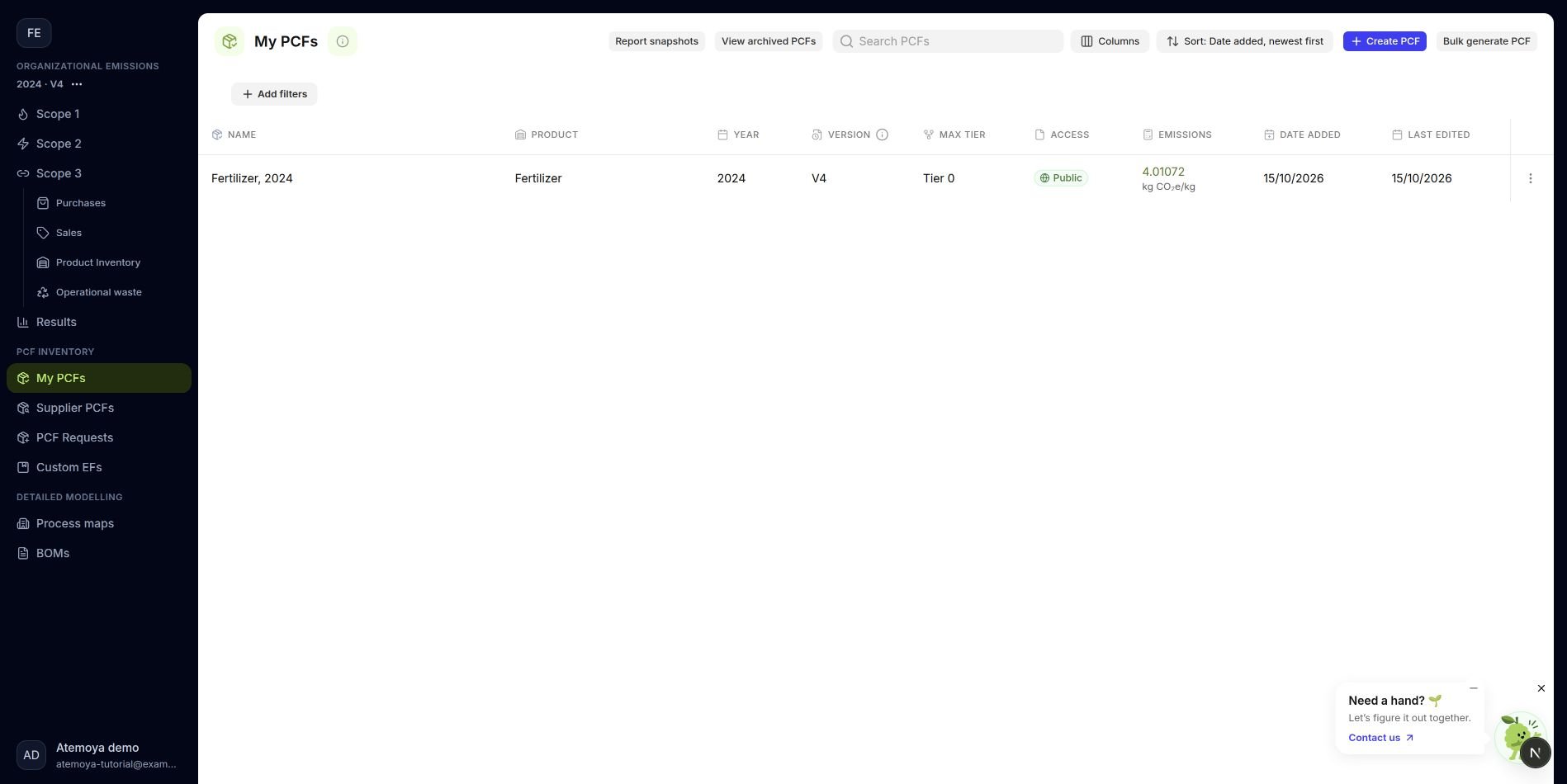 The demo's footprint is **PCF V4**, based on **organization V3**. These labels identify saved versions of the footprint and its source records; they aren't emissions rates.
This footprint uses annual company records. The demo doesn't use a separate product recipe, called a bill of materials or BOM.
The calculation is ready. The remaining step is making it available to the farm.
## 6. Share the footprint with the farm
In the demo, **Fertilizer, 2024** is public. The farm finds it in **Supplier PCFs → Public library** and adds it to its supplier inventory.
The supplier can create a **Restricted** PCF and respond to the farm's request under **PCF Requests → Received → Share PCF**. After checking the requesting company, product, and year, it selects **Fertilizer, 2024** and shares it.
The footprint then becomes available to the farm through that response. Public access makes it discoverable by other organizations instead.
The farm must still select the available footprint **on its Fertilizer purchase**, under **Emissions → Upstream PCF**. It confirms **1 kg purchased = 1 kg of the supplier's product**.
For the farm's **1,000 kg** purchase, that means **1,000 × 4.01072 = 4,010.72 kgCO₂e** in its **Scope 3**.
**Check the handoff:** the supplier's electricity was Scope 2. Why does its contribution reach the farm through Scope 3?
The supplier buys the electricity to make fertilizer; it's the supplier's Scope 2. The farm buys the fertilizer; the supplier's contribution reaches it through the fertilizer footprint used on that Scope 3 purchase.
The two companies keep their own accounts. Sharing a PCF connects the product information; it doesn't copy the factory's electricity into the farm's Scope 2.
Return to [Your workflow → Replace the fertilizer estimate](/user-guides/tutorials/atemoya-farm-demo#3-account-for-fertilizer-and-packaging) to see the footprint applied to the farm's purchase.
## About the sample data
The sample has no Category 3 upstream-energy purchases or other manufacturing activities. Before using it for reporting, review fuel and energy supply, process emissions, transport, waste, and other applicable sources. Adding records will change the result.
The saved factors come from **DESNZ 2025-flat**, **Electricity Maps 2024**, and **CBAM definitive-2026**. These reproduce staging's choices for the exercise; check the appropriate editions and methods for your report.
A saved organization version preserves the inputs. A snapshot captures the calculated values. See [PCF versions and snapshots](/user-guides/pcfs/versions-and-snapshots) when you need a fixed record, and review the source and sharing settings when updating your footprint.
This documentation is built and hosted on [Mintlify](https://mintlify.com), a developer documentation platform.