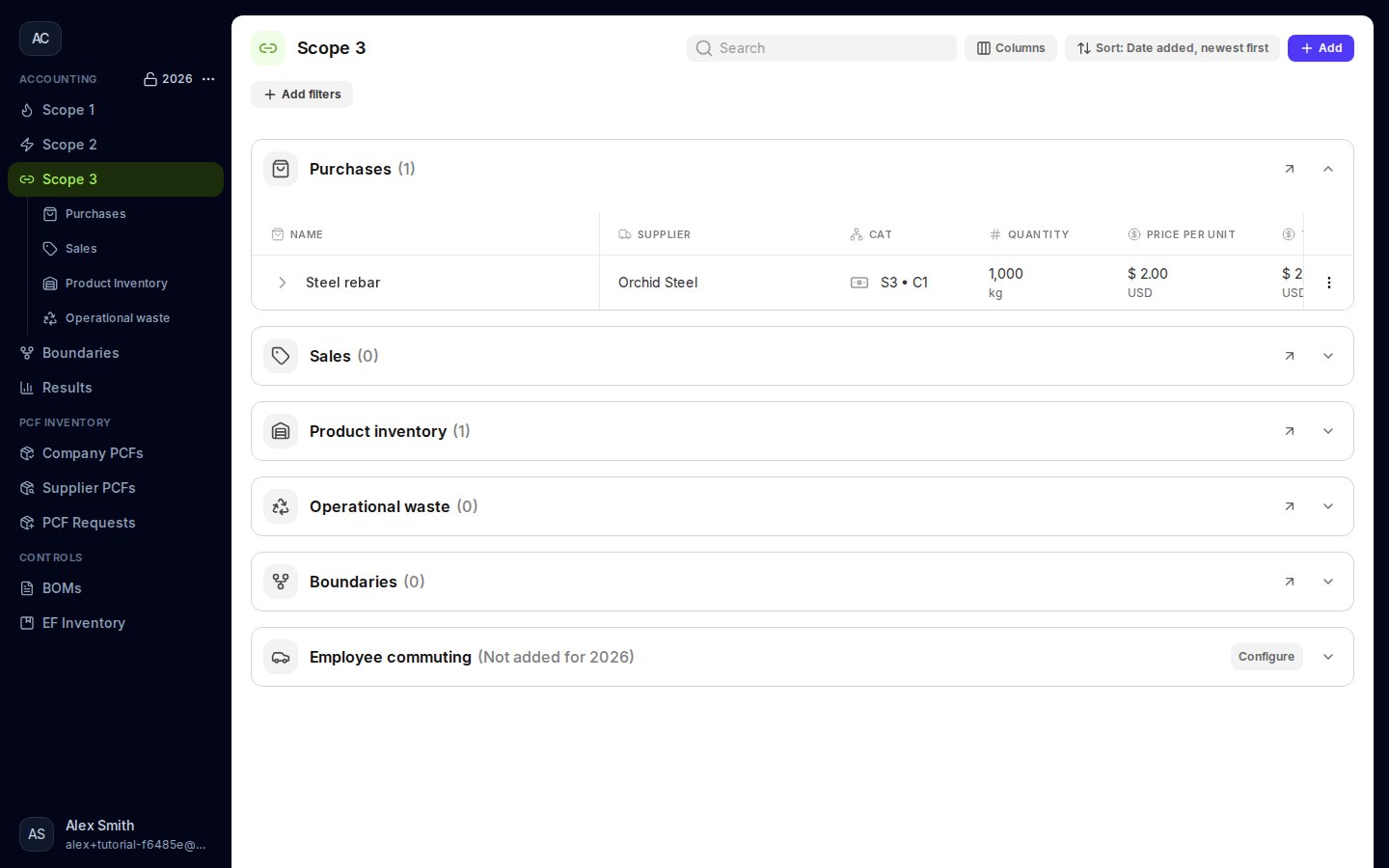
Navigate the connected purchases, sales, inventory, waste, commuting, and boundaries tables.
Open Scope 3 in the sidebar to review the tables for your current accounting year. Each section can be expanded or collapsed. The arrow in a section header opens its full table.
The overview and full tables use the same records.
Product purchases contribute to the accounting year’s Purchases total, and product sales contribute to its Sales total. Product inventory records stock at the start and end of the year, alongside annual production and consumption. Purchases and sales do not update those stock counts. The annual check is Opening + Production + Purchases = Closing + Consumption + Sales; emission factors describe the emissions associated with the relevant activities.Freight, business travel, upstream leased assets, service sales, and downstream leased assets are service activities and are not included in Product inventory. Electricity and purchased heating/cooling are also excluded from Product inventory.Use Configure in Employee commuting to add a commuting entry. Use Boundaries to define included entities; it is also available directly from the sidebar.
Check required fields, attached documents, product balances, and the factors used. Use the full tables for search, filters, columns, and row actions. Reviewing table data explains these controls.Changing the accounting year opens a separate set of records. Earlier-year purchases and sales remain in their own year, while previous closing stock carries into the next year’s opening stock.
Last modified on October 5, 2026
Assistant
Responses are generated using AI and may contain mistakes.